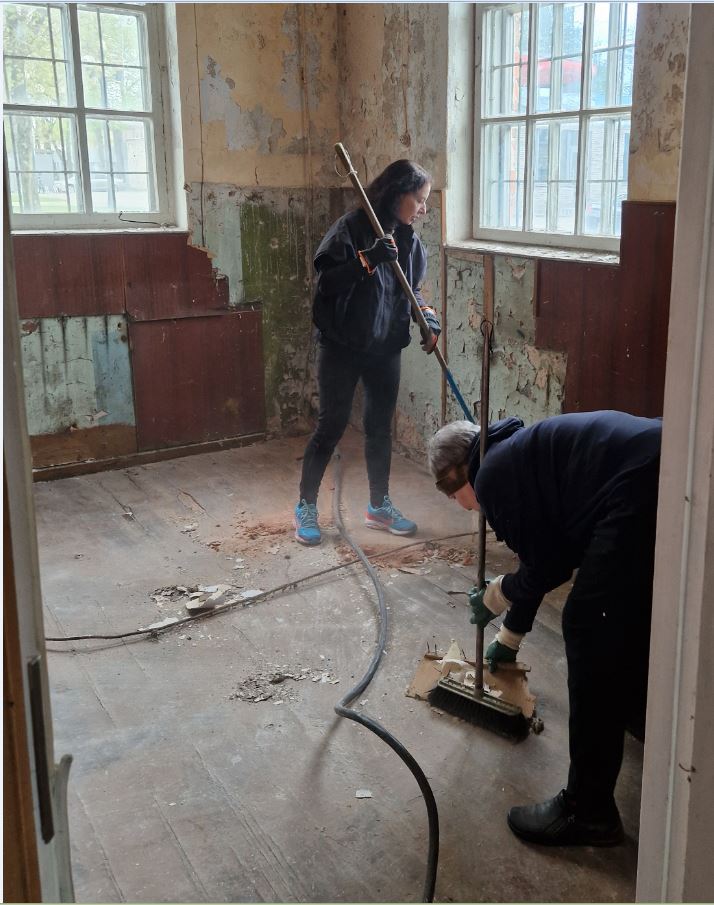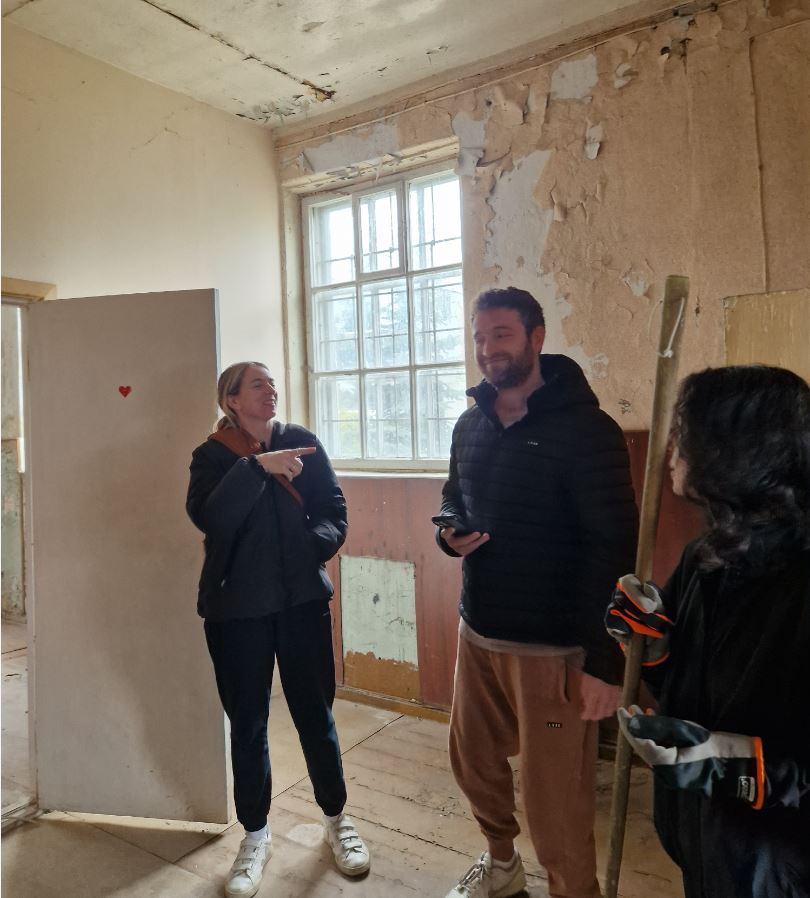

In mid-May, the initiative group CHEVRA TORAH of the Panevėžys Jewish Community organized another clean-up day in and around the synagogue.
History
Through the efforts of Abraham Abelskis, in 1910, on Valančiaus Street, on the Zundelis Abelskis plot, the aforementioned Chevra Tora brick synagogue was built. It was a prayer house for the Pentateuch study group, which only included men, but the synagogue also had a women’s gallery. The historicist-style building was unplastered, with decorative elements on the facades and Gothic-type windows, about 100 sq. m in size. The synagogue operated until 1940. The volume of the surviving building has not changed, but the facades have been significantly altered, and the interior has been destroyed. This Jewish heritage monument is one of several religious sites that have survived from the Jewish community and its organizations that once lived and actively operated in Panevėžys.
Jewish Heritage
A religious girls’ gymnasium operated on Ramygolos Street, and a general gymnasium operated on Elektros Street, where Hebrew was taught and which many famous people graduated from. Panevėžys, known in Yiddish as Ponevezh, is the fifth largest city in Lithuania, located in the central-northern part of the country. Jews began to settle in Panevėžys, on the left bank of the Nevėžys River, at the beginning of the 18th century. They developed trade, engaged in skilled crafts and small industry. The Jews of Panevėžys were among the first in Lithuania to engage in banking. At that time, Panevėžys was developing rapidly, and the number of Jews in the city was growing. In 1897, the Jewish community consisted of 6,627 people – about 51 percent of the city’s population. However, almost half of them were very poor. During that period, many Jews of Panevėžys emigrated to South Africa. Another decrease in the Jewish population occurred during World War I: Jews were deported deep into Russia, and only a few of them later returned. After Telšiai, Panevėžys was one of the most important strongholds of the Orthodox Jewish community in Lithuania. Its fame as a center of Torah studies spread throughout the world. In 1897, the city had one main synagogue, 12 prayer houses, and dozens of cloisters. Through the efforts of Rabbi Yitzhak Yaakov Rabinovich, a yeshiva was founded in 1908, one of the largest in Lithuania. His successor, Rabbi Yosif Shlomo Kahaneman, restored it in Bnei Brak in 1944. Today, it is considered one of the leading Litvak yeshivas in Israel. “A piece of Panevėžys in Israel,” wrote Panevėžio Balsas. The original pre-war yeshiva building still stands in the center of modern Panevėžys and is marked with a commemorative plaque. Initially, Jewish children were educated in Jewish study houses, but in 1863 a Jewish elementary school for boys and a religious school for girls were opened, offering alternative studies.
Jews in Panevėžys
In 1918, after the establishment of the State of Lithuania, three Jewish education systems operated in Panevėžys: Hebrew-Zionist, Hebrew-religious and Yiddish. As in any larger city, the Jewish community of Panevėžys included a small group of so-called intelligentsia, completely assimilated into Russian culture. They were little interested in social or national affairs, some of them sympathized with the Bund or Zionism, especially its socialist tendencies. During the Nazi occupation, the Jews of Panevėžys were forced to live in a ghetto established on the outskirts of the city. On August 24–26, 1941, the Germans and their Lithuanian collaborators began the extermination of the community. The Jews were taken to the Pajuostė Forest and shot in pits there. After the war, during the Soviet era, a monument with the Star of David was erected on the mass graves. This symbol was rarely used in Lithuanian monuments of that time. The Panevėžys Jewish Cemetery was opened in the 18th century and later expanded twice. After World War II, Jewish burials ceased there, as there were very few Jews left in the city. The cemetery was closed in 1955. In 1966, the city authorities liquidated the cemetery and replaced it with a city park with a fountain in the middle. Tombstones were used for construction in Panevėžys – some of them were even incorporated into a decorative wall near the J. Miltinis Drama Theatre. In 1980, an attempt was made to repair the damage: the fountain was moved to Senvagė, but an open pit remained at the cemetery site. The newly restored Panevėžys Jewish community honored the memory of the dead in 2009, when the sculpture “Mourning Jewish Mother” was unveiled. Today, this territory is included in the Lithuanian Cultural Heritage Register as a historical monument. In 2018, an information board was unveiled at the Jewish cemetery.
We invite you to donate
The Panevėžys Jewish Community is asking for support to restore and repair the Panevėžys Torah Society Synagogue. Not only was the Torah Society Synagogue a house of prayer, it was also a place for the community to gather, testifying to the flourishing Jewish culture that was tragically cut short during the Holocaust. By preserving this synagogue, we will not only save an architecturally significant building, but also foster the history and memory of the Panevėžys Jewish Community.
More information: https://gvf.lt/en/donate-2/